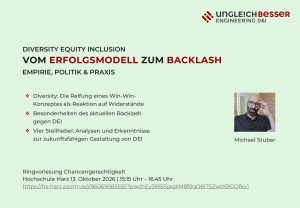
DEI Backlash as a wake-up call for Companies
The current backlash against DEI is often portrayed as a politically motivated aggression. International research adds a more uncomfortable element: DEI has also made itself disputable. Long-term learning says: companies should not simply rebrand nor retreat or revolt. They need to rethink what makes inclusion credible, relevant and impactful.
DEI discourse has changed dramatically. What used to be a broadly supported organisational and management approach is now being challenged at its very foundations. Yet evidence shows how long-term development provide explanations and current responses reach beyond a simple go woke or fold choice.
In a guest lecture at Hochschule Harz, I brought together three decades of practical and research-based insights with recent findings on backlash reactions. Three immediate conclusions stood out:
- Resistance is not new. It has repeatedly challenged and improved DEI over decades.
- The current backlash is different. It questions DEI’s legitimacy and institutional role, not just specific elements.
- The response can neither be activism nor retreat. Companies need a context-relevant, credible and inclusive DEI approach.
Companies are selectively adapting DEI – no simple answers
The headlines suggested a near-total corporate retreat with activist exceptions. Data tell a more differentiated story.
In a US survey of 400+ CXOs, 58% said they did not intend to change their spending on diversity-related work. 23% planned to increase it, while 19% thought of reducing it. A parallel review of US corporate reporting (before vs. after January 2025) found that 53% had adjusted their positioning (language and scope), particularly in the technology sector. In a separate European survey, only a minority of executives anticipated substantial changes in DEI.
The emerging picture is one of selective adaptation, not a general rollback or collective uproar. Companies are changing terminology, reducing communication and reviewing representation targets or related measures and incentives. Many continue their work, often with different organisational structures (mainly global players change this).
These nuances matter a lot. For political pressure can certainly influence corporate decisions – especially where public contracts are involved. But the very business challenges that made DEI work relevant in the first place have not disappeared: innovation need, productivity focus, talent attraction and retention, market proximity and the ability to solve complex issues.
How a successful concept became vulnerable
Why has an approach that developed as a win-win-idea over decades come under such pressure? Our analysis examined the evolution of DEI through specific lenses: its rationale, its positioning in the organisation, the framing and language – and the international influences shaping its development. Three key aspects help explain the current fragility.
- Complexity created vulnerability
Over time, DEI became broader, deeper and more interconnected. It moved beyond business practice into politics, society and academia. All this created new opportunities, but also more competing expectations and dependencies. The wider the agenda, the harder it became to maintain coherence and common ground – and several elements offered themselves as targets for fierce criticism.
- Some founding values became less visible
Diversity originally aimed to involve everyone constructively, without stereotyping or excluding people on the basis of demographic characteristics. Yet, in a few DEI contexts, identity categories, group hierarchies and moral divisions shaped the field’s perception. This weakened the idea of a shared endeavour and made the concept disputable.
- DEI became increasingly politicised.
Diversity initiatives used to attract support from across the political spectrum, albeit for different reasons. More recently, tensions of equity vs. meritocracy, universal inclusion vs. emphasis on disadvantaged groups, or even regarding constructed political meanings of symbols, created disconnect and polarisation.
The current backlash is, in part, an effect of these tensions. It is certainly not just another round of criticism. It challenges the legitimacy and institutional anchoring of DEI all together.
Four priorities for companies
Neither defending past practices, elegantly rephrasing existing concepts nor dropping the topic will resolve the situation. Companies need to focus on what makes DEI credible, useful and sustainable in their context.
1. Make the combined business and human rationale clear
Fair treatment and equal opportunity are concerns for everyone. So are the organisation’s specific needs. A convincing case connects the two. There has never been a universal business case that applies to all companies. The reasoning must fit the business model, its workforce, its industry sector, its DNA and the progress it wants to create. Another emotional DEI campaign will not deliver a sound explanation.
2. Make it everyone’s specific responsibility
DEI can no longer sit mainly with a specialist function – and should not mainly be shaped by interest groups. Leaders, HR and operational teams all have something to contribute and gain. People with different backgrounds and perspectives need to be part of the development. If DEI wants to overcome exclusion it cannot afford to create new exclusions.
3. Turn shared values into everyday practice.
Emotional statements of intent are easy on world x-y day. Consistent behaviour year-round is a different story. Companies must clarify what they stand for and how their values translate into behaviours, decisions and collaboration. In this context, differences and power dynamics must be discussable issues – without assigning people to divided moral camps.
4. Connect global principles with local needs
Experts have always agreed: A tool that works in a US tech company may not work in a German industrial business or an international investment firm. Industry, region, ownership structure, legacy and organisational maturity all matter. As selective adaption is now paramount, blueprints must be replaced by a smart combination of universal principles and local needs.
Not back to the roots. Refreshed and equipped for the future.
DEI has not been a simple success story. It is an evolution through research, criticism and practical learning – and of vast tensions emerging all along the way.
The current backlash has made some DEI weaknesses impossible to ignore. This is uncomfortable for many, and it creates opportunities. The underlying business and societal realities continue to drive DEI needs: workforces and markets are diverse; complex challenges require different strengths and perspectives; and organisations need the ability to adapt. DEI delivers all this, if approached in a meaningful and inclusive way.
Therefore, the future of DEI will not be shaped by labels, stories or public declarations. It will be decided by whether companies will be able to turn
- differences into strengths,
- processes into fair opportunities,
- cultures into high performing platforms, and
- collaboration into better outcomes – for the business and for the people.
That requires less ideological positioning – on all sides –, more analytical rigour and a much stronger connection to organisational reality.
Michael Stuber is a Leadership & Culture Advisor and founder of Engineering D&I. His work combines more than 20 years of international practice with research-based insights into diversity, leadership and organisational culture.
This English article is an adapted translation of the author's original German publication. It has been translated and editorially developed with AI assistance, and reviewed and finalised by the author.