
Three situations when Leadership must un-learn
For decades, leadership relied on a successful playbook: Define a vision, align the team, execute. But today’s organisations face new realities. The tensions are no longer just between strategy, people and processes.
A whole set of new tensions emerged from geopolitical and societal shifts over recent years. Organisations and their leaders were never prepared for issues that are no longer just operational and rooted in business – they are cultural, systemic, and deeply human.
Where values and identities create tension – and require new leadership
Three situations increasingly expose the limits of traditional leadership. They relate to the development of growing individuality – over decades – while the business world was aiming for more standardisation, in particular due to digitalisation and an appetite for eternally growing profits.
- When external expectations (from markets, politics, society) collide with business priorities
- When diverging personal values clash with organisational realities or needs
- When transformation (M&A, restructuring) reveals friction beyond the expected cultural integration
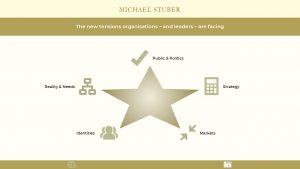
These aren’t separate topics and challenges. They reflect a structural tension that defines modern leadership: The gap between what organisations demand and what humans actually need to thrive.
Leading in complexity: the illusion of management formula
The scenario is familiar: A leadership team faces competing demands – shareholders want growth, employees demand purpose, regulators insist on compliance. The instinctive response? Simplify and satisfy all of them to some (preferably low) degree. Focus on the core (of the business agenda). Streamline priorities (according to operational frameworks). The new dimension we have seen emerging shows: Complexity isn’t the issue. The refusal to engage with it is.
Consider a global medtech company where executives struggled with diverging stakeholder expectations. Investors pushed for profit and growth, while employees and regulators demanded long-term sustainability. The new solution was created when leaders mapped the tensions instead of trying to eliminate them. We ensured that all stakeholders understood each other’s perspectives and – on that basis – identified overlap (instead of competing positions). This still integrated non-negotiable expectations and it increased alignment. The result wasn’t less complexity—it was clearer signals in a messy world.
More about this scenario: https://en.michael-stuber.biz/engineering-leadership-in-complexity-aligning-business-priorities-with-diverging-dynamics/
One further reading about the future of leadership: https://en.diversitymine.eu/leadership-diversity-ims-lux/
When values collide: the cost of polarisation
Workplaces always mirrored societal realities – but were assumed to be non-political, neutral, almost fenced. Today, everybody brings their convictions – aka values – to work, and the workplace sees similar polarisation like the one we see in society. Workplace discussions don’t stop at hybrid work, DEIB, or ethical dilemmas – they extend to business development, leadership practice and execution priorities. Most crucially, companies as entire organisations are expected to position themselves in the current ‘culture wars’ as they sometimes call it: Woke or anti-woke?
In this context, leaders are caught between taking a stance or staying neutral – a false dichotomy that fuels resentment. Neither approach works. Taking strong positions, of one side, will alienate some of many. Trying to stay silent is perceived weak and hiding, and leaves a vacuum others will fill in no time.
A mobility scale-up faced this when debates over hybrid work (and other questions) revealed deeper divides. Some individuals valued office presence for ‘culture’ while others demanded flexibility for innovation and efficiency. Avoiding the topics drove conflicts underground and we eventually set up general dialogues. The spaces were designed to meet and discover, to speak and create solutions – together. We did not have to include the ‘hot topics’ in the invitations or questions – they invited themselves and were tackled both naturally and constructively.
“Values aren’t the problem. The absence of a framework to negotiate them is.”
More about this scenario: https://en.michael-stuber.biz/engineering-cultures-when-values-collide-integrating-identities-belonging-and-business-realities/
One further reading about facilitating change: https://en.diversitymine.eu/understanding-fake-di-change-2021-c/
Leading through transformation: when cultural integration is not enough
At recent events, managers reported about an inflation of change initiatives. Not to complain but to illustrate the scope of their leadership task vis-à-vis transformation. M&A projects will reach a new peak in 2026 and restructuring needs emerge on a quarterly base as the world seeks a new order, digitalisation soars, and business models are reinvented. In these situations, leaders learned to focus on processes and communication, and now realise that this approach will go overboard on day 2. Structural decisions are taken quickly – but alignment, trust and clarity don’t follow at the same pace.
Sense-making won’t work when the pace of change is high. Role-modelling is unrealistic when new realities appear every other day. The bottom-line is: trust and shared purpose collapse, while they must be the base for constructive transformation. This happens when cultural integration is on everybody’s radar but no one understands the depth of making it happen.
In various transformation situations, we made sure that not one culture or norm was imposed on the new context. Instead, we helped everyone to see the journeys to date and where the intersection or overlap was. surfacing assumptions and co-creating new ways by everyone for everyone led to move from “How do we explain the change?” to “How do we own it together?”
More about this scenario: https://en.michael-stuber.biz/transformation-change-restructuring-m-and-a-post-merger-integration/
One further reading about how context shapes progress: https://en.diversitymine.eu/context-shapes-success/
The cross-cutting conclusion: tension isn’t the problem – it’s the material
These three situations share a root cause: Leadership models treat tension as a problem to solve, not a dynamic to navigate. 20+ years of DEIB told us how to make this happen in the best possible way.
From managing to engineering culture: a different kind of leadership work
Traditional leadership development focuses on clarity, alignment, and execution – assuming stability. Yet today’s tensions demand a different skill set:
- Exploring dynamics (not just symptoms): Looking for overlap starts with mapping expectations and find intersections.
- Designing dialogue: Aiming not for a miracle one-off workshop, but a moderated process to keep up the discourse (and development)
- Bridging gaps: Aligning strategy with cultural realities – not by imposing a framework, but by co-creating it
This isn’t about managing tension – it’s about using energy as valuable material for progress.
Why familiar solutions fail (and what works instead)
Most organisations default to simplification (e.g. ‘core priorities’) or symbolic gestures (e.g. events). But these fail because they ignore three key layers.
- Societal/political: public expectations clash with shareholder demands
- Industry-specific: tech’s fast pace can’t adopt R&D or financial risk aversion – and vice versa
- Organisational heritage: unwritten rules resist strategic mandates – regardless of urgency
The alternative? Engineering leadership and culture that focuses on
- Contextualising: tailoring approaches to realities and maturities
- Co-creating: involving employees in shaping change
- Iterating: treating culture as a living system, not a programme that can be reset
The paradigm shift: tools vs. systems
Many experts rely on tools which are undoubtedly important. In our times, however, leadership and culture must also focus on systems. That’s where new approaches are critical for success.
- Cultural diagnostics: Uncovering inherited values and implicit norms that determine dynamics
- Dialogue as a lever: Structured conversations that turn conflict into shared understanding
- Learning journeys: Not training, but experiential processes where teams explore drivers and overlap
The result? Leaders stop managing tension and start engineering it – turning friction into momentum, conflict into creativity, and complexity into competitive advantage. This isn’t about quick fixes. It’s about building systems where human dynamics and business priorities reinforce each other, and create a resilient future for all.
Here is a Youtube Playlist where I talk about Values, Culture and Performance (English subtitles)
